Why Some Films Work in a Room… and Others Don’t
What we’ve learned programming Coffeehouse Cinema
Ellis J. Sutton, Coffeehouse Cinema
culture, laevents, film, cinema, film community, short films, microcinema, moviegoing, movies, coffeehouse cinema, hollywood, third spaces, film culture, filmstack
We didn’t set out to define what makes a short film “work.”
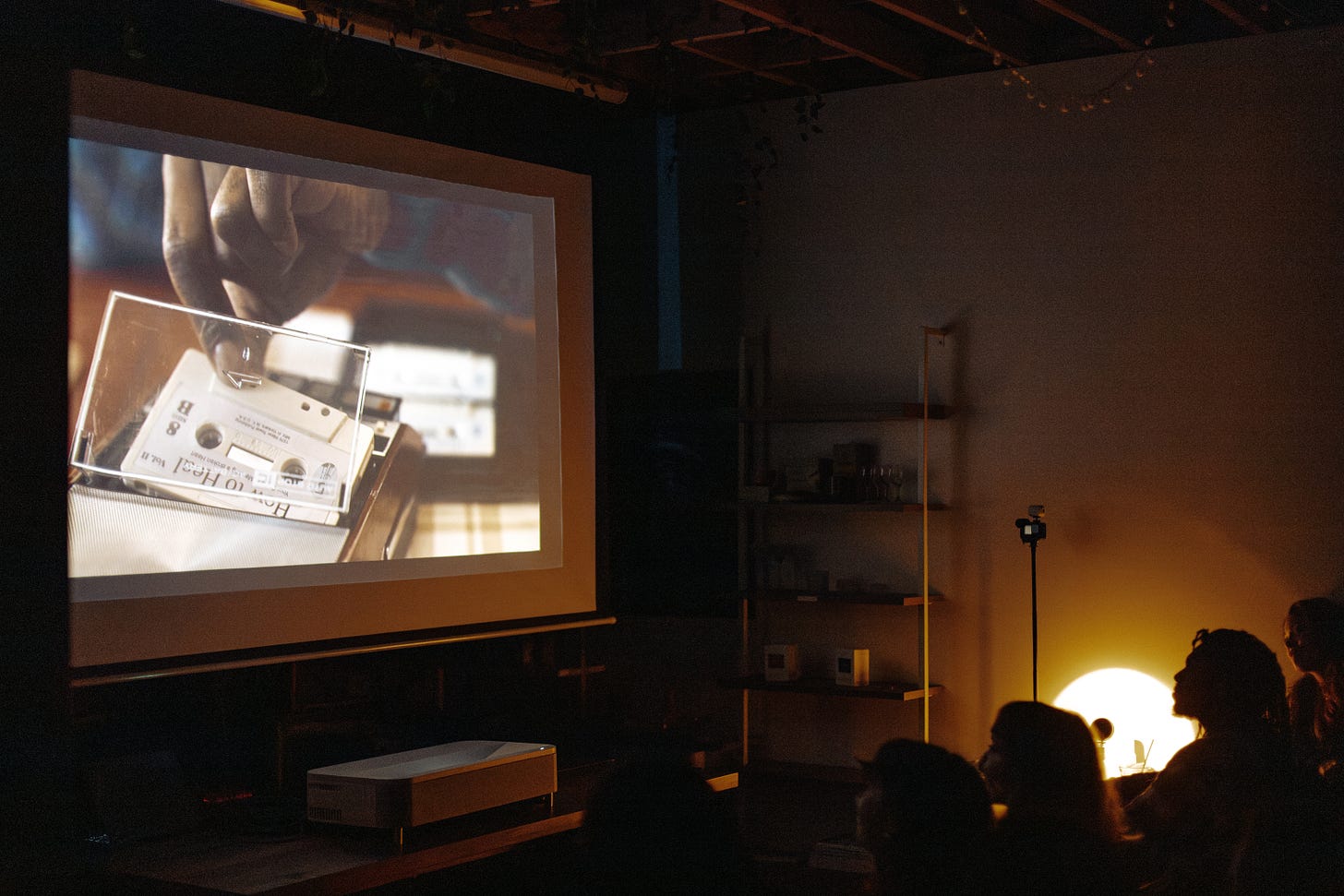
But after four months of programming Coffeehouse Cinema, sitting in the room, and watching how audiences respond in real time, certain things have become hard to ignore.
Some films connect instantly. Others take longer. And some, despite being well-made, never quite land the way you expect them to.
So the question became: what’s the difference?
What We Look For at Coffeehouse Cinema
At Coffeehouse Cinema, so far, we’ve mainly been getting submissions through referrals, word of mouth, friends, and the occasional DM.
But people continued to ask us: what kind of movies does Coffeehouse Cinema actually program?
For a while, I didn’t really have a clear answer. It’s one thing to imagine what you like, but it’s another thing to actually screen films, sit in the room, and feel how an audience responds in real time.
Now that the series has grown and we have about four months of programming behind us, it’s become a lot clearer. There are certain things that stand out, not just in the movies we’re drawn to, but in the movies our audience consistently responds to.
And I think that’s the most important thing to understand.
Coffeehouse Cinema is curated by Eddie and I, and a big part of that is still rooted in our personal taste, our instincts, our experiences, and the types of films we want to see.
But at the same time, we’re also paying close attention to the room.
We’re starting to understand what our audience is responding to, what they’re connecting with, and what kind of experience they’re showing up for. So there’s a balance that’s forming between our taste and audience expectation.
When we think about what we want to screen, it’s not just “do we like this?” It’s also “how will this play in the room?” and “is this the kind of experience our audience has come to expect from us?”
Rather than define our taste in abstract terms, we want to answer that question by looking at the films we’ve already screened and what we feel made them work.
What Stood Out to Us in Each Volume
When we started curating Volume 1, we were really just going off instinct, what we had access to, what we responded to, and what we thought might actually play well in the room.
But pretty quickly, a throughline revealed itself.
There was a strong connection between themes of death and connection. Each of the films, in some way, was dealing with some version of human connection, and at least three of the four films had a very direct relationship to death. That wasn’t something we set out to do. It was something we discovered after the fact. But it became a defining characteristic of that first block, and it showed us how powerful a thematic throughline could be in shaping the overall experience.
For Volume 2, we were a bit more intentional.
We were programming during February, so we were thinking about both Valentine’s Day and Black History Month. That led us to prioritize Black protagonists and or Black filmmakers where we could, while also paying attention to stories that had some kind of romantic or relational core.
What stood out across that block was that each film centered around a character making a choice that, in one way or another, was driven by a desire for connection. Even though each film explored deeper themes beyond that, that underlying motivation tied them together in a way that felt cohesive without being overly obvious.
Volume 3 came together a bit differently.
We had a strong foundation early on with Mas Alla and It Takes a Village. Both films shared a coming-of-age quality, and both had a connection to nature and environment that felt really grounded and specific. Once we had those two, it became about finding the right third piece to complete the block.
Hatchlings ended up being that film. It reinforced the coming-of-age throughline and helped solidify the emotional and thematic cohesion of the block. On their own, each film works, but together, they created something more unified, something that felt like a complete experience.
For Volume 4, Callback and The Singers had some immediate, surface-level connections. There were shared collaborators between the films, which initially made the pairing make sense.
But what really locked it in was something deeper.
Both films are about performance, about characters revealing who they are through the act of performing. That became the core of the block. Again, not something that was overly stated, but something that became clear as we looked at them side by side.
One thing we’ve noticed in how we program is that the throughline of a block doesn’t always reveal itself right away.
Sometimes it starts with a few films we know we want to play. And then, as we continue to watch submissions, we start to understand what the block is actually about. From there, it becomes a process of finding the strongest way to support that idea.
It’s not about forcing every film to say the same thing. And it’s definitely not about being preachy.
It’s more about identifying a throughline that’s loose enough to give each filmmaker space, but strong enough that the overall block feels intentional and cohesive.
That balance is something we’re continuing to refine with every screening.
What Stands Out to Us
There are a few things that have become immediately clear in terms of what works well at Coffeehouse Cinema.
Immediate Engagement
In the short film format, it’s really important that a film can communicate, fairly quickly, what it is and what the audience should be leaning into.
That doesn’t mean everything needs to be spelled out, but there should be a clear sense of direction. What are we watching? What are we discovering? Why are we here?
The films we tend to respond to less are the ones that take too long to reveal themselves, whether that’s through subject, tone, or structure. In a room like this, that early connection really matters.
A Distinct Voice
Every film we’ve programmed has had a very clear voice.
We’re drawn to filmmakers who are making specific choices, whether that’s stylistically, tonally, or structurally. None of the films we’ve shown are perfect, but that’s not what we’re looking for.
What stands out is intention. You can feel when a filmmaker knows what they’re trying to do.
Emotional Clarity
The films we really connect with tend to have a strong emotional core.
Even when they fall into a specific genre, they’re still engaging, in some way, with the human experience. There’s something underneath the surface that we can latch onto.
On the flip side, the films we tend to move away from, even if they’re well made, are the ones that feel too narrow in scope. That could mean a single gag without much depth, something that feels overly insider, or a concept that doesn’t expand beyond its premise.
A comedy can absolutely be specific, but it still needs to reveal something, about the character, the situation, or the world.
Conversation-Worthy
Every film we program should give the audience something to react to.
That doesn’t mean everyone has to love it. In fact, some of the best moments come from disagreement. People interpret things differently. They connect to different elements. They walk away with different takes.
Even between Eddie and I, there are times where we don’t fully agree on what a film means, and that’s part of the point.
The films we gravitate toward are the ones that naturally spark conversation, sometimes in ways the filmmaker may not have even intended.
Immersion Over Production Value
We don’t program based on budget or production value in the traditional sense.
But we do care about immersion.
It’s not about having the best camera. It’s about whether the film pulls us into its world without distraction. Is the sound clear? Does the production design feel intentional? Are the performances grounded in a way that makes us believe what we’re watching?
We pay attention to the choices being made, framing, lighting, performance, design, not as a checklist, but as tools that either support the story or take us out of it.
If we’re thinking about how the film was made instead of being inside of it, that’s usually where it starts to lose us.
What This Means for Submissions
While many of the films we’ve screened have had strong festival pedigrees, including, in some cases, major recognition, that is not a requirement for Coffeehouse Cinema.
We are not programming based on where a film has played.
We are programming based on how it plays.
If the film connects, if it has a clear point of view, and if it gives an audience something to feel or talk about, it belongs in consideration, regardless of its release history.
When it comes to festival pedigree, it’s worth clarifying how we think about it.
We’re not chasing prestige, and we’re not selecting films because of where they’ve screened. Our audience isn’t coming to Coffeehouse Cinema for that either.
What we’ve found, though, is that when a film really lands, when it connects in the room, sparks conversation, and stays with people, and it also happens to have played at a major festival or received recognition, it makes sense. The response in the room and the recognition elsewhere tend to come from the same underlying qualities.
So it’s not about getting into a certain festival and then being considered by us. It’s about whether your film has the kind of clarity, voice, and emotional impact that allows it to stand out anywhere.
That’s what we’re responding to.
Moving Forward
Up until now, most of our submissions have come through referrals, word of mouth, and DMs.
That’s been a great way for us to discover films early on, but as the series grows, we’re moving toward a more formal submission process so we can give every film the attention it deserves.
In the near future, we’ll be directing all submissions through a dedicated platform.
So if you’re thinking about sending us your film, stay tuned for that, because that’s going to be the best way to make sure your work is properly considered.
In the meantime, we still appreciate people reaching out and sharing their work. Just know that we’re in the process of building something a bit more structured behind the scenes.
Coffeehouse Cinema will continue to evolve and take shape in a lot of different ways, many of which aren’t even fully clear to Eddie and I yet.
But as that process unfolds, we think it’s important to bring people along with us.
To share what we’re learning, how our taste is developing, and how these films are coming together in real time.
Because at the end of the day, this isn’t just about what we screen. It’s about building something that people can understand, engage with, and grow alongside.
Stay tuned for more from us and our filmmakers.
We’ll see you at the Coffeehouse.