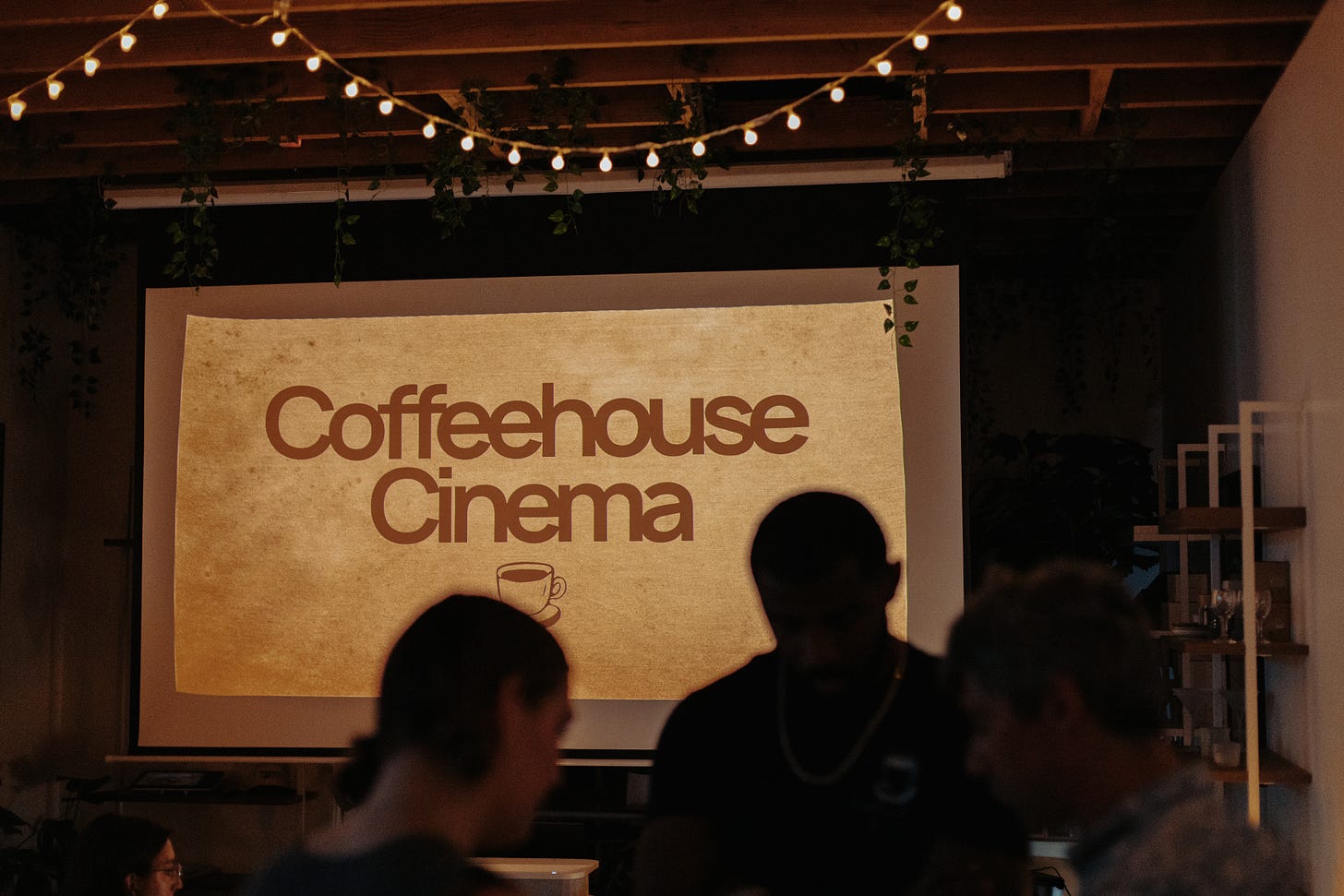
It's Starting to Click: Coffeehouse Cinema Vol. 4
How our biggest event yet brought our biggest challenges
Ellis J. Sutton, Coffeehouse Cinema
culture, laevents, film, cinema, film community, short films, microcinema, moviegoing, movies, coffeehouse cinema, hollywood, third spaces, film culture, filmstack
The Storm Before The Calm
“Need you here ASAP.”
That was the text I got from Eddie while I was still at work, not even able to get out on time.
Immediately, I was alarmed. This was shaping up to be our biggest Coffeehouse Cinema event yet. We had sold out faster than ever before. More people were expected than we had ever had.
And somehow, this was the moment when things started going wrong.
Earlier that day, I had already seen Eddie to drop off our speaker and materials so he could start prepping. We usually begin setup at 4:00 PM, right after the coffee shop closes. It takes us about two and a half hours to get everything ready before doors open.
This time, because of daylight savings, we started later. Doors were set for 7:00 PM.
Those extra 30 minutes ended up being everything.
When I finally got Eddie on the phone, he told me the sound levels for the films weren’t working.
Audio is already one of our biggest challenges in that space. The coffee shop isn’t built for screenings. When we run events, Eddie is usually in the weeds the entire time, manually adjusting volume throughout each film. It’s never perfect. Sometimes it clips. Sometimes it’s uneven. But we make it work.
So when he told me the sound wasn’t working at all, my first thought was: this could go really bad.
By the time I got there, we had a little over an hour before doors.
I realized pretty quickly that one of the films had been exported for surround sound instead of stereo. I’m not an audio tech, so it took me a minute to figure out the right fix. About 20 minutes just to get the settings right.
Then another problem.
Rendering the corrected version would take about 30 minutes. When that first render finished, I realized we had accidentally cut the end of the film short.
At that point, doors were about to open.
I had to start the process over.
We switched to Eddie’s laptop, which we don’t usually use for screenings. My laptop is typically the safer option, but we didn’t have time to be precious about it.
So as people started arriving, I wasn’t fully there.
Usually, during pre-reception, I’m present. Talking to people, welcoming them in, setting the tone.
This time, I was half in conversations, half out of them.
In the back of my head, the only thing I was thinking was:
If these films don’t play properly, this whole night falls apart.
Ten Minutes till showtime
About ten minutes before we were set to start, Eddie and I stepped outside.
We quickly ran through what we were going to say. The run of show. The beats.
And then we looked at each other and said how interesting it was that all of these problems were showing up at the same time as things were starting to go well for us.
More people. More attention. More momentum.
And more pressure.
But that was exactly the point.
If this is what it’s going to become, then this is what we have to be able to handle.
Before the event started, I told Eddie there was still a chance the films wouldn’t play correctly from my laptop. We had issues with that before. Worst case, we would have to switch mid-event.
He said okay.
We went up, made our announcements, and I told the room to pray to the screening gods that everything would work.
Because there was a real chance it wouldn’t.
I clicked play.
And it worked.
The films played exactly how they were supposed to. The audio held.
The relief I felt in that moment was immediate. Physical.
And for the first time that night, I was actually there.
“…the best Singers screening in a coffee shop”
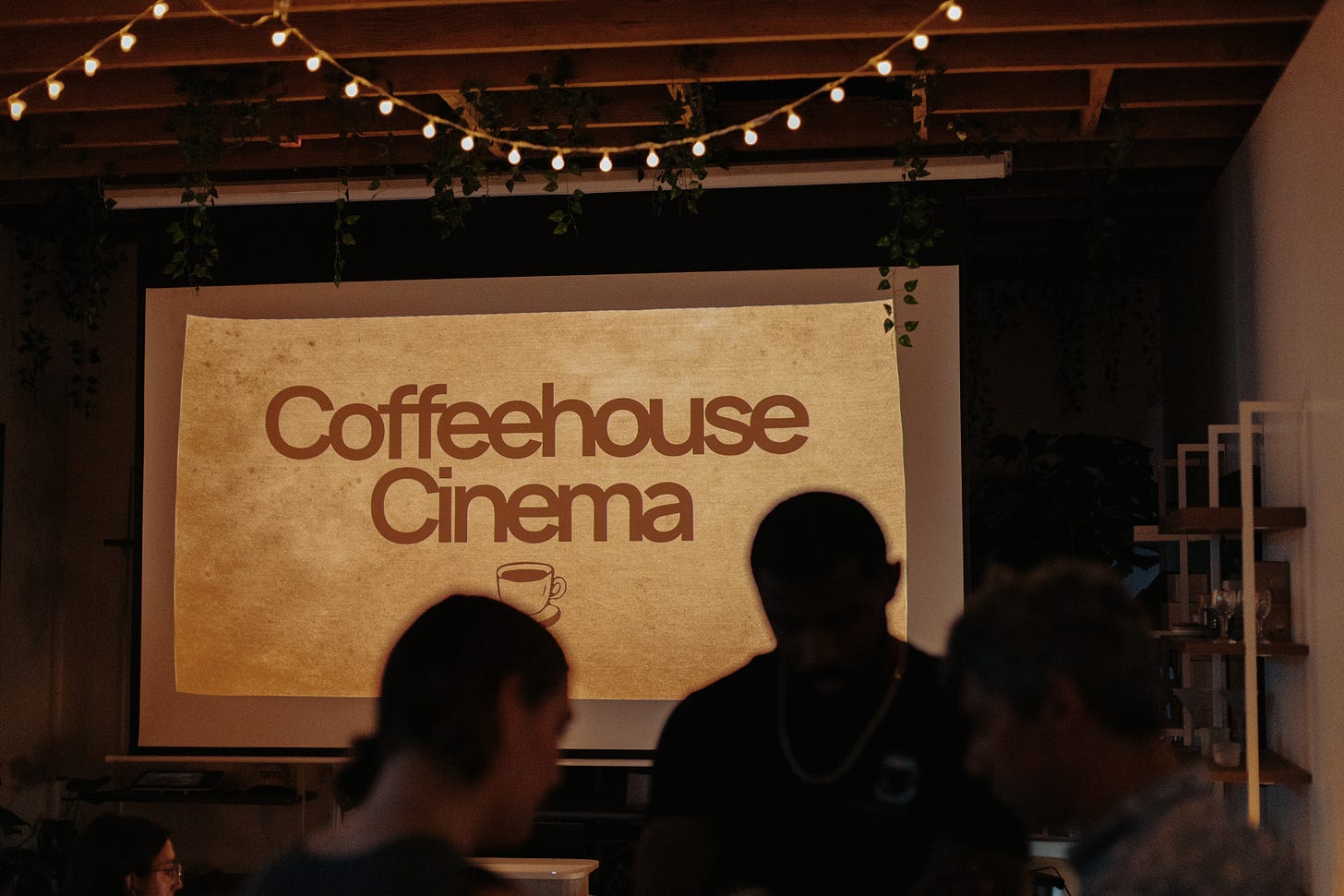
From that point on, I got to watch the room.
Not just the films. The room.
People were locked in.
Reacting. Laughing. Sitting in silence when it mattered.
You could feel the attention.
We got a quote from Sam Davis, the director of The Singers, who said,“This is the best Singers screening in a coffee shop ever.”
Which, to be fair, might have been the only one. But still.
It mattered to him that his film was being shown this way. That it was being taken seriously.
We also screened Callback, directed by Matthew Puccini, who is based in New York. Normally, we prioritize LA filmmakers, but this one had ties to our community. It was produced by one of our previous filmmakers, Matt Kazman, and shot by Sam.
It felt like the kind of exception you make when the ecosystem starts to connect back into itself. And the cherry on top was that each film featured characters in a performance competition midway through the film.
The Community in Action
After the Q&A, we transitioned into the social hour.
And this is where it started to click.
The way we reset the room.
The way people moved.
How quickly the space shifted from screening to conversation.
It was smooth. Natural. Faster than we’ve ever done it.
And People stayed, talked, and connected.
Multiple people told me they heard about the event through a friend who told them they had to come.
Some people showed up without even knowing what it was, just trusting the recommendation.
One of our previous filmmakers, Justin, said he was talking about Coffeehouse earlier that day in a coffee shop, and someone overheard him, thought it sounded interesting, and decided to come that night.
And they loved it.
That kind of word of mouth… you can’t fake that.
At one point, someone told us this was the most packed they had ever seen that coffee shop.
And it didn’t feel overwhelming.
It felt alive.
“This feels different”
When people come up to us and say, “This feels different,” it’s easy to brush it off.
To say we’re still figuring it out, and a lot of that is true. We’ve had a lot of help. A lot of people contributing to this in ways that matter. And we don’t have all the answers yet.
But at a certain point, it’s also important to recognize that this didn’t just happen.
Eddie, Christy, and I have spent a long time talking about what we wanted this to be.
What kind of room we wanted to build.
What kind of people we wanted in it.
What kind of experience would actually make someone want to come back, and bring someone else with them.
And how intentional we needed to be at every step to make that real.
Come As You Are
Because what we keep coming back to is this:
People are tired.
They’re tired of watching the same types of movies.
Tired of going to theaters and seeing the same thing.
Tired of scrolling endlessly through streaming platforms.
Tired of not feeling seen.
Tired of not feeling connected.
One person told me this felt like a place where you could just show up as you are.
I compare it to church. Which, to be clear, we are not.
But the idea behind it stuck with me.
This isn’t a space that asks anything from you.
But if you show up, and engage, and stay open to it, you’ll get something out of it. And while it’s easy to say none of this was by design, almost all of it was.
See you at the Coffeehouse,
Ellis
P.S. We’ll be transitioning posts like these to our paid subscribers, so if you like this and want to support what we’re doing at Coffeehouse Cinema, consider switching to our paid tier.