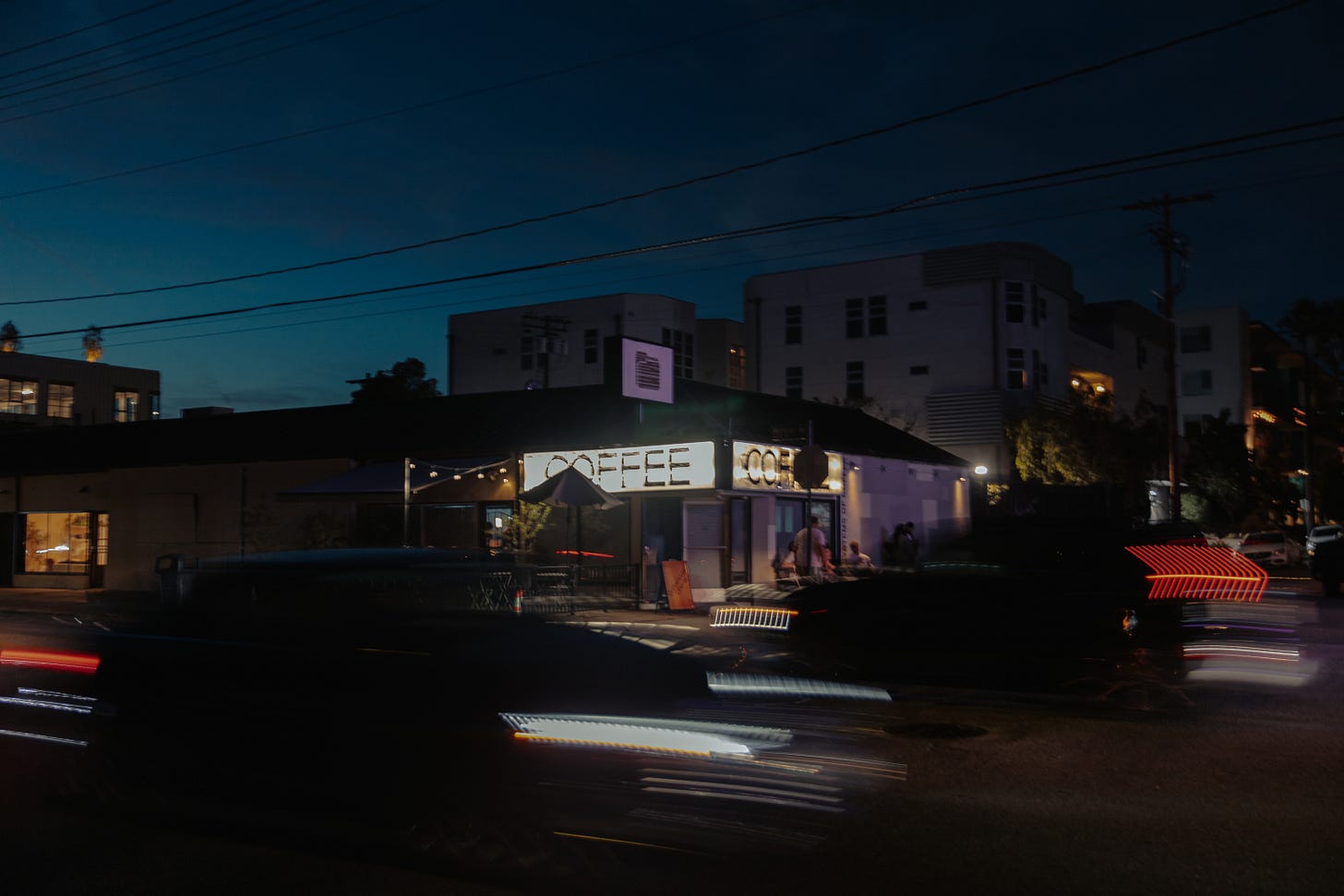
I’ve Run a Microcinema for 3 Months. Here’s What I’ve Learned.
Or: why people don’t actually watch short films and what happens when you give them a reason to.
Ellis J. Sutton
culture, laevents, film, cinema, film community, short films, microcinema, moviegoing, movies, coffeehouse cinema, hollywood, third spaces, film culture, filmstack
Most people don’t watch short films.
Not really.
They will support them. They might like a post, click a link, maybe even skim through one if a friend sends it.
But actively seek them out? Choose to spend a night watching them?
Treat them as entertainment instead of obligation? Nope. Not even a little bit.
For most people, watching a short film is tied to context, not interest.
It is because a friend or family member made it.
Because they are in film school.
Because they work in the industry.
Because they are part of a small circle where watching short films means something.
Outside of that, short films do not exist in people’s actual viewing habits.
And I do not think that is because people do not like them.
I think it is because no one has really given them a reason to.
Three months into running Coffeehouse Cinema, that is the question everything keeps coming back to:
What would it take for someone to choose short films the same way they choose anything else they watch?
As I still continue to learn lessons from running Coffeehouse Cinema, here are just a few takeaways so far.
1. If you treat it casually, people will experience it casually
At the beginning, I thought we were just putting on screenings.
Find a space, set up a projector, invite people. That should be enough. I was wrong.
I realized that how you present something tells people how seriously to take it.
If the space feels thrown together, the films feel disposable.
If the environment feels intentional, the films feel important.
So I stopped thinking about it as an event and started thinking about it like I was building a film.
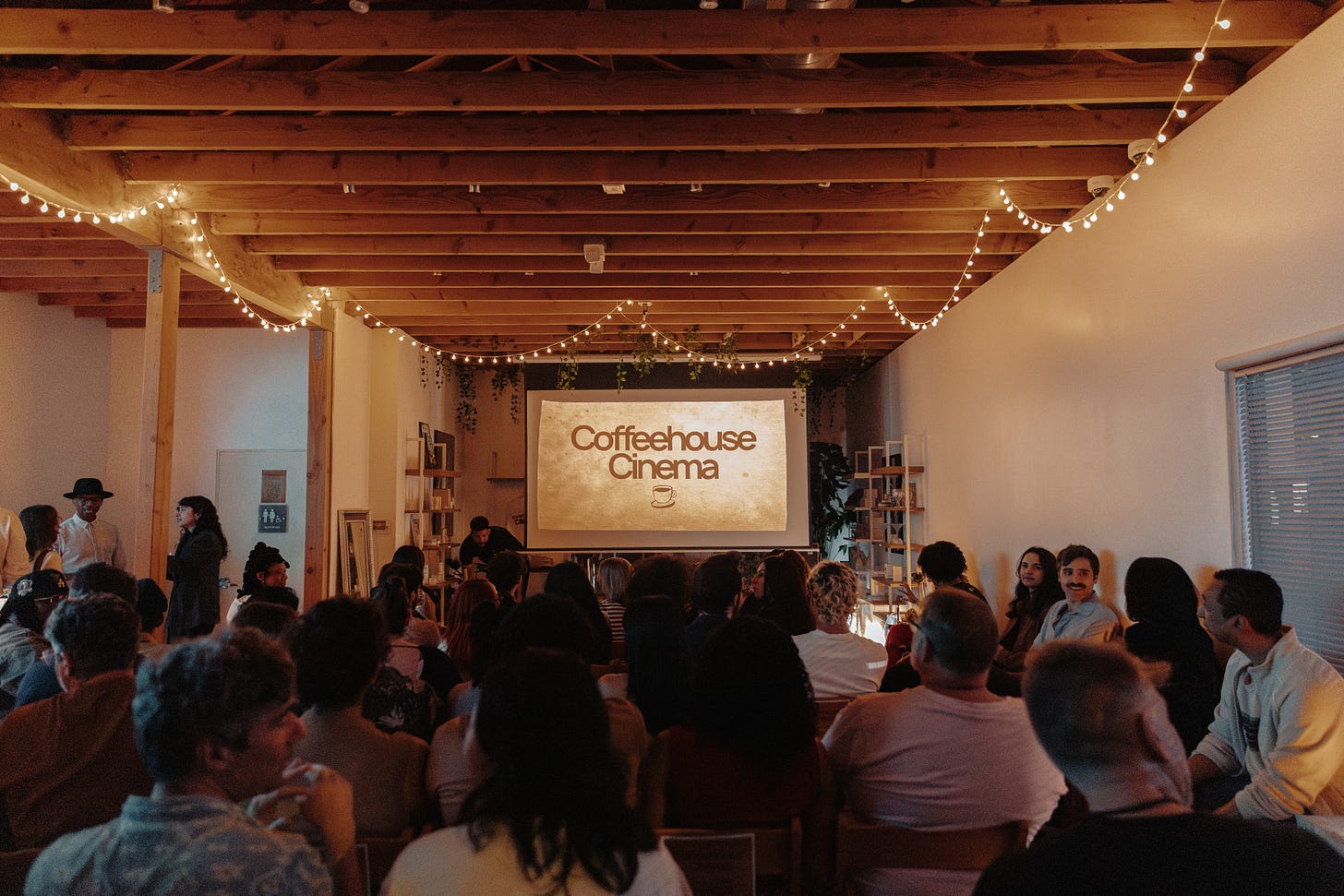
I went on Pinterest and started collecting references. Not of theaters, but of spaces. Coffee shops and environments that felt warm and intimate. Places where you would actually want to sit and stay.
I was looking for event inspiration, but really I was trying to define a feeling.
And then we tried to build that in real life.
One big we have learned is that none of this happens alone.
Everything people experience when they walk into Coffeehouse Cinema, the layout, the lighting, the atmosphere, is the result of people volunteering their time to help shape it.
Moving chairs, tables. Adjusting lights. Reworking things that do not feel quite right.
It is much closer to production design than event planning. And that care translates.
People might not consciously understand why a space feels good. But they feel it. And when they do, they engage differently with everything inside it.
2. The film is not the whole product and it should not be
One of the biggest mistakes you can make is assuming the film is the entire experience. It is not.
The experience starts the moment someone walks in the door.
At our first event, Eddie’s sister brought a charcuterie board. It was not part of a larger strategy. It just felt right for the space. Shoutout to Courtney from Xarcutería Los Angeles.
But people responded to it immediately.
That was the moment it clicked. People are not just reacting to what they are watching. They are reacting to how they feel while they are watching it.
The lighting matters.
The seating matters.
The food, the smell, the energy in the room all matter.
If you ignore those things, you are asking the films to do all the work.
And that is unfair to the films.
Because even great work can fall flat in the wrong environment.
3. Curation is not taste. It is structure.
I used to think curation meant having good taste.
Pick strong films. Support filmmakers you believe in. That is the job.
But that is only the baseline.
What actually makes a screening work is structure.
Eddie, our Head of Programming, pushed me to think about programming as a conversation. How films relate to each other. How they build on each other. How they contrast.
Now we are not just asking, “Is this film good?”
We are asking, “What happens when this film is placed next to this one?”
What kind of emotional arc does that create? What ideas start to emerge across the block? That is what people remember.
Not just individual films, but the feeling of the sequence.
4. Constraints are what make it real
At some point, we made a decision that made everything harder. We prioritized filmmakers based in LA.
On paper, this limits you immediately. Fewer films. Fewer options.
But it creates something more valuable.
If filmmakers are local, they can attend.
And if they attend, the experience expands beyond the screen.
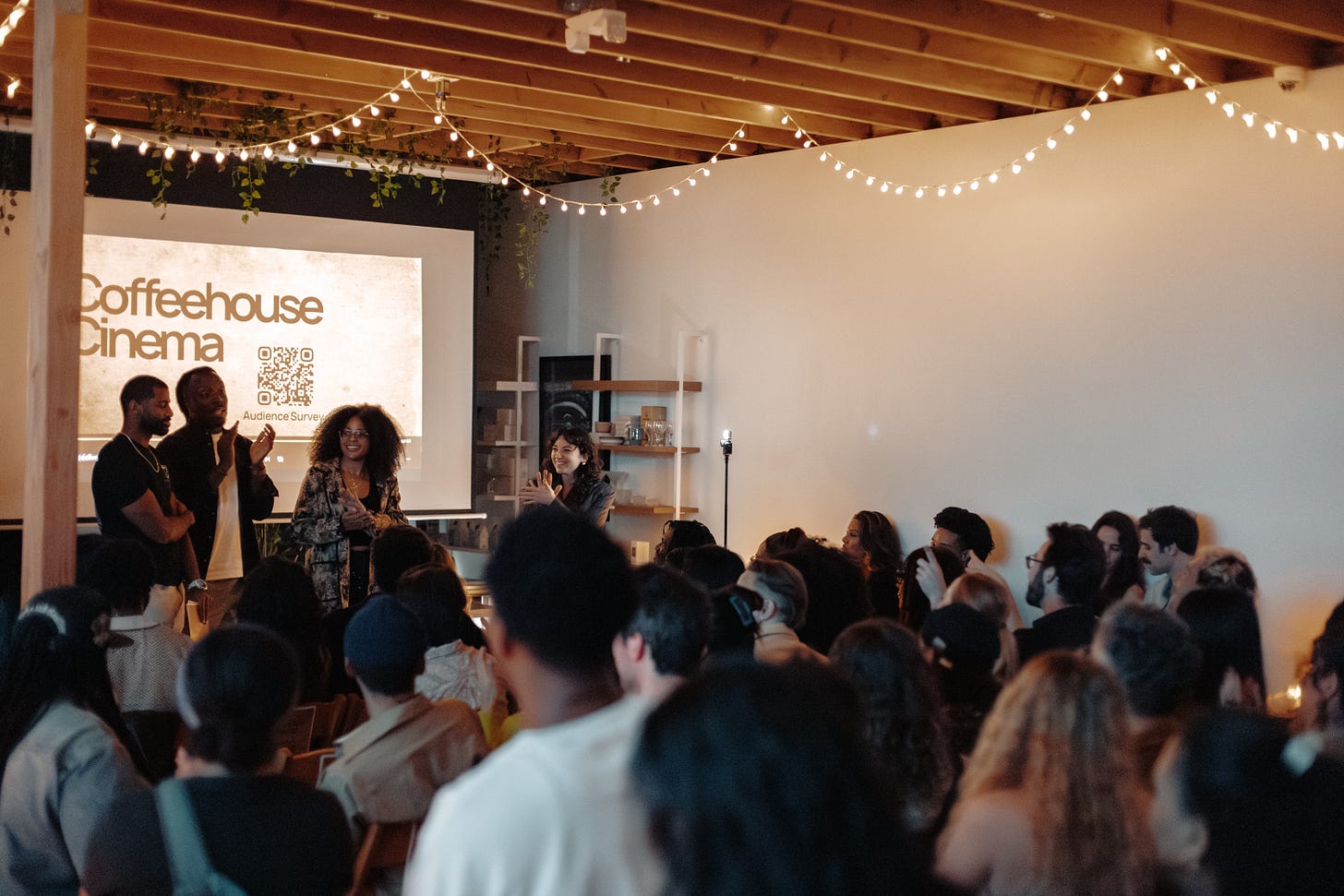
Now the audience is not just watching. They are in conversation.
The Q&A stops being a formality and becomes part of the core experience. The work feels more immediate and more human.
But this constraint meant we could not rely on passive discovery.
So we leaned into referrals.
Filmmakers recommending other filmmakers. People who understood what we were trying to build and could point us toward others who fit.
That network has become one of the strongest parts of what we do.
And it only exists because we did not try to make things easy.
5. Short films do not have a demand problem. They have a framing problem.
This is the biggest shift for me.
Short films are not ignored because they are less interesting.
They are ignored because of how they have been positioned.
For years, they have been treated as practice. As stepping stones. As the thing you do before the real work.
So audiences learned to treat them that way.
Why go out of your way to watch something that even the industry frames as temporary?
But when you remove that framing, when you present short films as complete, intentional works, and build an experience around them that reflects that, people show up.
Not out of obligation. Not because they know the filmmakers.
But because they trust that what they are about to watch is worth their time.
And once that trust is established, something shifts.
They pay attention differently, and they engage more deeply.
More importantly, they come back.
Not for a specific film, but for the experience of discovery itself.
What we are actually building
It is easy to say we are building a microcinema, but that is not really it.
We are building a place where short films are taken seriously and where audiences are invited to do the same.
A place where the experience is intentional enough that people do not feel like they are taking a risk by showing up.
Because that is really the barrier.
It is not that people will not watch short films.
It is that they will not gamble their time on something uncertain.
So the job becomes removing that uncertainty.
Making it clear through the space, the programming, and the people involved that this is worth it.
And if you can do that consistently, over time, people start showing up because they want to.
Short films were never the problem.
The way we have been showing them is.
We are not trying to convince people to watch short films.
We are building a place where they do not have to be convinced.
We’ll see you at the Coffeehouse.